Global Markets in 2025: A Year of Volatility, Resilience, and Perspective
Apr 22, 2025


As we progress through the first half of 2025, the global financial landscape is once again being shaped by a dynamic mix of geopolitical tensions, economic shifts, and investor sentiment. The year has opened with heightened volatility across nearly all major markets, driven largely by trade policy disputes, regional conflicts, and uncertainty around global interest rates. But while headlines may suggest instability, history—and diversification—offer a more balanced view.
A Turbulent Start: The Impact of Geopolitics
The most prominent driver of market movement in 2025 has been the escalation of trade tensions between major economic powers, particularly the U.S. and China. A fresh round of tariffs and retaliatory measures in early January sent shockwaves through equity markets. The S&P 500 fell sharply, ending Q1 down approximately 15%, while technology-heavy indices like the Nasdaq experienced even sharper swings due to their global supply chain exposure.
Europe has not been immune. The Stoxx 600 index saw modest declines of around 6%, reflecting investor concern over energy security and slower-than-expected industrial growth in Germany and France. In Asia, Japan’s Nikkei 225 bucked the trend, posting a surprising 12% gain—driven by strong corporate earnings and a renewed domestic investment push.
Meanwhile, China’s Shanghai Composite fell about 2% amid weaker consumer spending and continued property sector stress. Emerging markets showed mixed results: India’s Nifty 50 posted a resilient 6% gain, buoyed by strong tech and banking sectors, while Brazil’s Bovespa rose 7% on commodity demand and interest rate cuts.
Unusual Volatility, Not Unprecedented
What sets 2025 apart isn’t just the scale of volatility, but its frequency and intensity. Markets have been whipsawed by sudden shifts in policy rhetoric and real-time military developments in Eastern Europe and the Middle East. But while the news cycle can be unsettling, volatility itself is nothing new.
In fact, if we look back just five years, 2020-2021 offered a dramatic example of rapid declines followed by even sharper rebounds. During the COVID-19 crisis, U.S. markets fell 34% in a matter of weeks, only to surge by over 70% within a year. Investors who remained disciplined and stayed invested were rewarded with one of the most powerful recoveries in market history.
The lesson? Volatility may test your patience, but it often creates opportunity.
The Power of Diversification
This year has reinforced one of the core principles of investing: diversification. In a year when the S&P 500 is struggling, markets like India, Japan, and select sectors in Latin America are delivering strong returns. Currency movements, sector rotation, and regional differences in policy responses have led to divergent performance across the globe.
A globally diversified portfolio helps investors avoid over-reliance on any single economy or market. While U.S. equities have historically been a strong performer, periods like 2025 show the value of spreading risk across geographies and asset classes.
Historical Perspective: Bear Markets vs. Bull Markets
From 1926 through 2024, the U.S. stock market experienced 19 bull markets—each defined by a gain of 20% or more from a previous low—lasting a combined 1,006 months. During the same period, there were 18 bear markets (20%+ declines), lasting just 177 months in total. The long-term trend overwhelmingly favors those who remain invested.
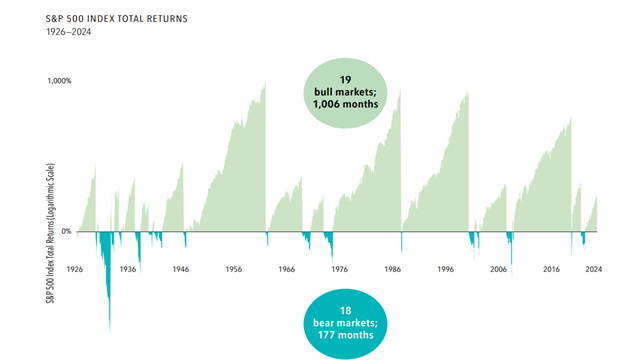
The following chart from Bloomberg, courtesy of Edgepoint, puts some perspective on the total returns of the US bulls which far outweigh the total losses of the US bears in the last eighty years. Patience is rewarded in total return strategies.

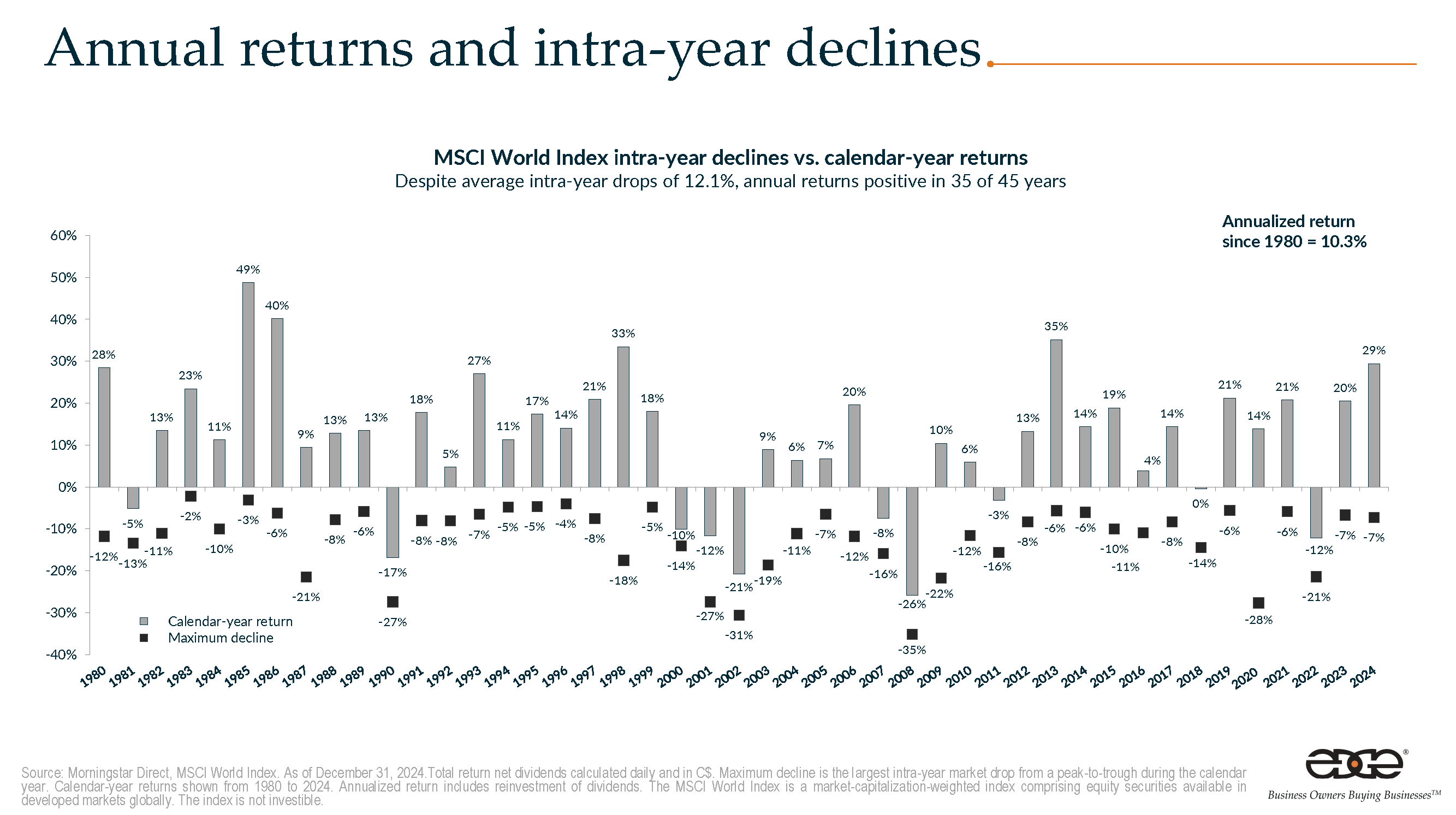
Another important perspective is the emotionally painful annual volatility of returns demonstrated in this Morningstar chart of the very diverse MSCI World Index over the last 45 years. Intra-year declines and changing annual outcomes are commonplace. Despite an average intra-year decline exceeding 12%, attempting to time the market fluctuations would quickly diminish the likelihood of achieving the best long-term results.
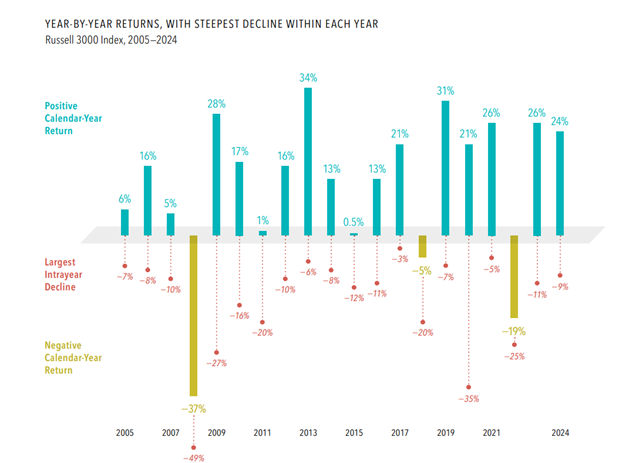
The market intra-year declines are similar regardless of business size (market capitalization). This chart of the widely capitalization diversified Russell 3000 Index, over the last 20 years, shows that investors received positive returns in 17 of them. Even in years with sharp intra-year declines, many ended with gains by year end. This resilience underscores a critical point: timing the market is nearly impossible, but time in the market works.
Economic Fundamentals Remain Steady
Beyond market headlines, broader economic indicators continue to point to long-term strength. GDP data for the U.S., Europe, and Emerging Markets, for example, show continued growth despite lingering inflationary pressures and central bank interventions. Job markets remain resilient, and corporate earnings, while uneven, reflect adaptability in changing environments.
These fundamentals provide a solid foundation for recovery once uncertainty begins to fade.
Final Thoughts: Stay the Course
2025 has already delivered its share of drama—but this is not the first time investors have faced uncertainty, and it won’t be the last. Market corrections and volatility are the price of admission for long-term growth. Historically, those who maintain a diversified, disciplined investment approach through difficult periods have been rewarded.
Unfortunately, many investors let their emotions overrule rational principles and inevitably they try to time their investments around market events. The resulting lack of successful timing is starkly demonstrated over the last twenty years in this chart of consensus investment flows being reactive and mis-aligned with actual returns potential.

It is a common human condition to emotionally anchor to recent events, and another behavioral condition to extrapolate a current outlook or uncertainty into the future. This is not new, nor is it unique.
The consensus view is often incorrect. In hindsight, the “consensus” can be seen as emotionally reactive especially when fueled by media selling headlines. An interesting historical demonstration of this fact is demonstrated in the charts below showing Time magazine covers espousing headlines that rightly should have been ignored!


So, if you’re feeling uncertain about your current strategy amidst the media noise or want to revisit your investment policy mix in light of global events, we understand, we’re all human. If you need additional reassurance, now is an excellent time to connect. We’re here to help provide clarity, context, and guidance.
Your long-term goals haven’t changed—neither should your plan.
Tax Planning
Tax planning can be also complex and hard to understand, because everyone's situation is unique. Below, we look at different financial situations and how we'd suggest each person proceed to get the most favorable result.
Learn More