


The Performance Trap: Measuring Portfolios Wrong
Jul 21, 2026


A retirement case study — what’s actually going on in your portfolio
As I sat across the table from Jim, I could tell there was something weighing one him. He looked at me carefully, slid a monthly statement across the table, and asked a question many retirees quietly carry: “Have I even made any money over the last decade?”
The problem isn’t Jim’s diligence, it’s how he’s measuring performance.
The Four Most Common Ways Investors Miscalculate Performance
- Measuring performance from a market peak – The Mountain Peak Mirage
- Using book value instead of true returns – The Leaky Bucket Illusion
- Ignoring withdrawals when assessing growth – The Statement Math Trap
- Comparing to the wrong benchmark – The Apples vs. Oranges Race
Let’s take a closer look at Jim’s situation.
A Closer Look at Jim’s Portfolio
Jim holds a Registered Retirement Income Fund (RRIF) worth approximately $500,000, invested in a balanced portfolio:
■ 60% Vanguard Total International Stock Index Fund (VXUS) – Equities
■ 40% Vanguard Total International Bond Index Fund (BND) – Fixed Income
To support his lifestyle, he withdraws about $2,500 per month after tax.
This portfolio was never designed to “win” on a month-to-month basis. With a long-term return target of roughly 6%, its purpose is steadier: generate dependable income, manage risk, and preserve purchasing power over time.
Yet each month, Jim focuses on a single number: the ending balance.
That’s where things start to go wrong.
- Measuring Performance from a Market Peak

Jim remembers his portfolio reaching $580,000 earlier in the year. That number has become his reference point. Every statement since is judged against that high-water mark.
This is a classic example of anchoring; this is a behavioural bias where we fixate on a specific number and use it as a benchmark for everything that follows.
The issue is that markets don’t move in straight lines. Even a well-functioning portfolio will fluctuate.
When performance is measured from a temporary peak, normal volatility can feel like failure.
2. Using Book Value Instead of True Performance

Jim’s method is simple: compare book value to market value and decide whether things are “good” or “bad.”
Unfortunately, this “statement math” leads to misleading conclusions.
Custodial statements are excellent at tracking holdings, transactions, distributions, and fees. But they’re not designed to measure investment performance. A portfolio’s balance changes for many reasons, some of which have nothing to do with returns.
One of the biggest sources of confusion is cash flow, particularly reinvested income. Mutual funds and ETFs distribute dividends, interest, and capital gains. If those distributions are reinvested, they increase the book value of the investment. From a tax perspective, this is beneficial as it may reduce future capital gains, but it complicates performance measurement.
If you compare book value to market value without accounting for reinvested distributions, you will understate the actual return.
3. Ignoring Withdrawals When Assessing Growth
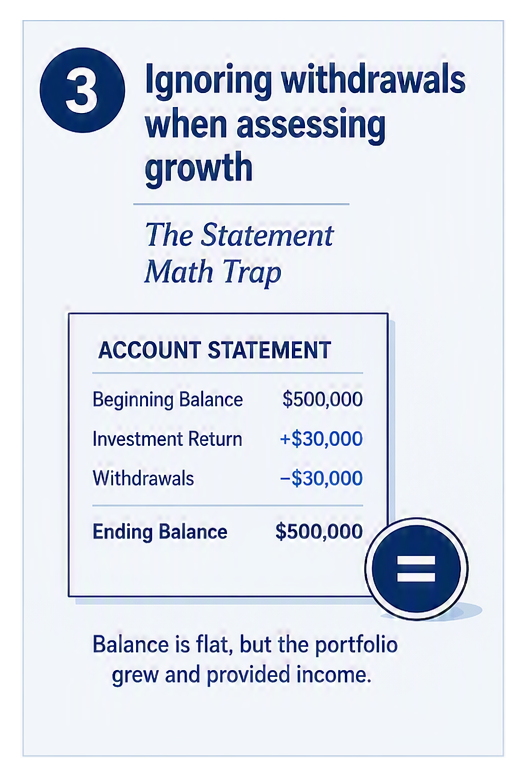
Now consider Jim’s withdrawals. At $2,500 per month, he takes out roughly $30,000 per year to fund his retirement. Even if the portfolio generates positive returns, those regular withdrawals reduce the visible balance.
Imagine a year in which the portfolio earns a solid return, but the ending balance is flat or slightly lower.
To Jim, that looks like poor performance. In reality, the portfolio may have done exactly what it was built to do:
■ generate investment returns;
■ provide consistent income; and
■ stay within an appropriate risk range.
The key distortion here is cashflow. When money is being withdrawn, the ending balance alone cannot tell you how the portfolio performed.
4. Comparing to the Wrong Benchmark

Like many investors, Jim compares his portfolio to what he hears in the news, usually a broad equity index like the S&P 500.
“I saw the market was up quite a bit last year,” he says. “Why didn’t my account reflect that?”
The answer lies in risk.
Jim’s portfolio is 60% equities and 40% fixed income. That means a significant portion is intentionally invested in lower-volatility assets. Comparing it to an all-equity index ignores that difference.
Benchmarks only work when they reflect the structure and risk level of the portfolio being measured. A balanced portfolio should be compared to a balanced benchmark, not a growth-oriented stock index.
What Proper Performance Measurement Looks Like
It’s easy to fall into these traps. Performance measurement requires accounting for multiple moving parts, and our instincts tend to simplify what we see.
But a declining or stagnant account balance doesn’t necessarily mean poor performance, especially in retirement.
A meaningful performance report should include:
■ deposits and withdrawals;
■ fees and expenses;
■ income distributions (reinvested or paid out);
■ transfers in and out;
■ appropriate benchmark comparisons; and
■ alignment with the Investment Policy Statement (IPS).
The key takeaway from Jim’s situation is simple: Measured the right way, performance often looks very different than what a quick glance at a monthly statement suggests.
And in retirement, understanding that difference can be the key to having confidence in the plan. ■
Estate Planning Misconceptions
In this 5-minute webinar, we explore an important but often misunderstood area of financial planning.
Learn More


