


Case Study: Optimizing Retirement Income and Estate Planning for Multi-Generational Support
Apr 29, 2025


Jack (age 75) and Jill (age 62) are a retired couple with three children and six grandchildren. They’ve built a strong foundation with more than $2.9 million in investments, a mortgage-free home, and a solid pension plan paying $50,000 per year.
They are looking for a plan to help their children without jeopardizing their own financial security
and to keep income and estate taxes to a minimum.
Goals
Income of $120,000 net after taxes and provide some support for their three children who have young families and mortgages. They also want to provide some gifting to their grandchildren.
Assets
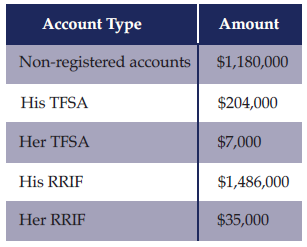
Retirement Income
Jill has a pension worth $38,500 per year and Jack has a pension worth $10,800 per year. This is approximately $50,000 combined income not including Old Age Security and Canada Pension Plan benefits.
This is an excellent base income that they can depend on for life.
They are able to generate a net spendable income after tax and after inflation of about $185,000 a year until Jill’s age 95. This assumes that they earn 4% over inflation real rate of return. They could achieve that with a 60% stock and 40% fixed-income portfolio. Even with a more conservative portfolio, they would be able to generate more than their target of $120,000.
I suggest they prepare their portfolio for income by putting three years’ worth of withdrawals into a cash reserve consisting of a money market fund and laddered one- and two-year GICs. The remaining amount will be invested in a diversified portfolio. This strategy is used to take out the volatility of equity-based investments. Unless a stock market decline lasts longer than three years, they should not be forced to take an income from their investments while they are declining in value.
Reducing Tax Liability
They have more than $1.5 million combined inside their retirement accounts. Jack is withdrawing the minimum required from his Registered Retirement Income Fund (RRIF) each year. I would suggest increasing the withdrawal amount from the registered funds because it is fully taxed on the second spouse’s death. They should get funds out of the RRIF over their lifetimes at a lower tax rate if possible, as the highest marginal tax bracket is 53.5% in BC.
Jill is 13 years younger than Jack. They are able to income split their pension income at a 30% marginal tax rate while both are alive. If Jack died, Jill’s marginal tax bracket would increase to 38% to maintain the same level of income. I suggest using both of their marginal tax brackets to reduce the potential RRIF tax liability.
Tax-Free Savings Accounts
(TFSAs) are great to accumulate funds for estate planning. You pay no taxes on the earnings so your
money can grow faster. You can hold your TFSA as long as you live, and the balance can be passed to your spouse. It looks like Jack has been fully maximizing his TFSA and has generated some good gains inside, but Jill has considerable contribution room available. They should maximize this account to provide for future flexibility and the potential to provide a tax-free estate for their children. This may require selling some stocks inside their non-registered account and triggering capital gains, but this would allow for potentially 30+ years for Jill’s account to grow their estate tax-free.
Gifting
Cash gifts now would be a good financial move for them and their family. This allows Jack and Jill to reduce their estate value and future tax liability, and provides help to their children at a crucial point in
their lives when they could best use the cash gift. Their children’s lives are at an expensive stage with
young families to provide for and large mortgage balances.
The alternative for Jack and Jill would be to defer and accumulate the funds, pay more taxes in the future, and give the money to their children as an inheritance in potentially another 30 years.
At that time, their children would be at or close to retirement with less need for the money. A cash gift now would have the best impact per dollar on the lives of their children and grandchildren.
If they were to reduce their non-registered portfolio by $300,000, they would be able to generate
a net spendable income of about $175,000 a year until Jill’s age 95. They could provide a $100,000
cash gift to each child and still be able to maintain their standard of living.
For their grandchildren, Jack and Jill can look into opening a Registered Education Savings Plan
(RESP) account. They can contribute $2,500 per grandchild per year, and the government will
match up to 20% of annual contributions to a maximum of $500 a year per beneficiary. An annual
gift of $15,000 per year would allow them to maximize the annual RESP contributions for all
their six grandchildren. This would allow them to reduce the value of their own estate and their
potential tax liability in the future.
The gift of an RESP would also be a huge help for their children as well, since they’d have the security
of knowing that their own children’s education is fully or partly provided for.
The Plan
Draw down their RRIFs during their lifetimes while using the extra income to gift to family. Set aside three years of liquid investments in case of a market downturn. Gift $100,000 to each child now and open an RESP for each grandchild. ■
Estate Planning Misconceptions
In this 5-minute webinar, we explore an important but often misunderstood area of financial planning.
Learn More


