


Financial Impacts of Losing a Spouse
Jul 17, 2025


Losing a spouse or close family member is one of life’s most emotionally devasting experiences. Amidst the grief, there is a new financial reality that sets in. From funeral costs to a sudden change in household income, the loss can alter financial stability just as deeply as it shakes emotional foundations.
The theoretical case study below explores some of the financial impacts of losing a spouse by looking at cash flow changes, taxable income implications, and tax planning considerations:
Background
John (deceased at age 65) and Mary (62) had been married for 35 years and lived in their own Vancouver home before John passed away. They have two adult children who are financially independent.
Their assets and income sources included:
Home
Principal residence with an assessed value of $2.2 million and mortgage-free
Investments
- John’s RRIF: $500,000
- John’s TFSA: $200,000 (TFSA room is fully maximized)
- Mary’s RRSP: $700,000
- Mary’s TFSA: $200,000 (TFSA room is fully maximized)
- Joint Non-Registered Account: $800,000
Pension & Income Source
- John’s CPP: $12,000/year
- John’s OAS: $8,400/year
- John’s Defined Benefit Pension: $30,000/year (with 60%
survivor benefit) - John’s RRIF income: $20,000/year
- Mary’s CPP: $7,200/year (estimated at age 65)
- Mary’s OAS: $9,300/year (estimated at age 65)
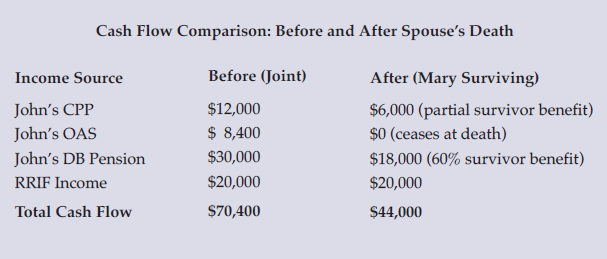
Taxable Income Implications
Income Splitting Is No Longer Available
- John and Mary were previously able to split the pension and investment income to reduce their overall tax bill
- Mary now must report all the income herself, pushing her into a higher marginal tax bracket
Change in Marginal Tax Rates
- When John and Mary were splitting income, they were both in the 22.2% marginal tax bracket
- In other words, every additional dollar of income they had was taxed at 22.2%
- After John’s passing, Mary is now in the 28.2% tax bracket
Tax Planning Considerations
RRIF Rollover
- John’s RRIF can roll over tax-deferred to Mary if she was designated as the successor annuitant
- If this was done, there would be no immediate tax cons- quences on John’s passing
- Mary will start receiving the RRIF withdrawals in her name
TFSA Rollover
- John’s TFSA can roll over to Mary if she was designated as the successor holder
- Going forward, Mary would only be eligible to make contributions for herself once new TFSA room is available each year (John’s room is no longer available)
Pension Income Tax Credit
- Mary can qualify for the $2,000 pension income tax
- credit (even though she is not age 65) because the RRIF income was received as a result of John’s passing
CPP Survivor Benefit
- Mary will be eligible for a CPP survivor benefit that is calculated as the sum of a flat rate portion plus 37.5% of John’s CPP
- The total amount of CPP that Mary will receive will not fully replace the combine CPP they would have received if John was still alive
OAS Clawback
- OAS clawback will not be an issue in this case because the threshold for 2025 is $93,454 of net income
Principal Residence
- No changes or tax considerations assuming home is not sold
- Home maintenance costs would not change materially
Non-Registered Account – Investment Income
- Investment income (dividends, interest, capital gains) will now be taxed in Mary’s name only
Final Tax Filing Deadline for John
- If John passed away between January 1 and October 31, his final return is due April 30 of the following year
- If John passed away between November 1 and December 31, his final return is due six months from the date of death
Additional Considerations
- Funeral costs, legal fees, and accounting fees can be significant and overwhelming
- While some household expenses may decline, other costs like strata fees, property taxes, monthly subscriptions, and car insurance generally remain the same
- It may take time to adjust to the lower level of cash flow, but it is important to reassess cash flow needs as soon as possible
Summary
Losing a spouse can bring significant financial repercussions, especially when the cost of living is high. Shifts in household income, income tax implications, and tax planning are a few examples of factors to consider in the event of a death in the family.
Proactive financial planning is not only essential but also reassuring and grounding when navigating the most turbulent changes in our lives. Supporting clients to understand the intricacies of the range of factors relevant to their unique situation is one of the most relationally meaningful aspects of the financial planning profession. Financial planning empowers you to make informed decisions and take control throughout the entire spectrum of life. ■
Why do we plan?
Knowing where you are translates into knowing where you're going, and we hope to provide every client with the trust and confidence to navigate through the waters of their financial lives.
Learn More


