To Cut or Not to Cut – That is the Question
Sep 19, 2025


Trying to predict which way variable interest rates will move is like playing a slow game of chess— you try to anticipate a central bank’s next move before you make yours. The central bank’s “move” would be whether to increase, decrease, or leave interest rates the same. Your “move” would be whether to take a fixed or variable rate for your mortgage or loan.
The moves you make can be critical to your overall financial health whether you are re-negotiating the mortgage on your home, financing a rental property purchase, or taking out a loan for your business.
Two types of interest rates are generally available: “fixed interest rates” which are influenced by bond yields, and “variable interest rates” which are influenced by central banks. Central banks lend money to the chartered banks (such as RBC, TD, and Scotia) at a specific rate (in Canada, the overnight lending rate) and then the chartered banks lend money to consumers. The rate at which the banks lend money to consumers is called the “Prime Rate of Lending”, and lenders often offer a “discount off Prime’. If Prime were 5% and a lender offered Prime -1%, then the rate you’d receive would be 4%. As Prime rate decreases, your rate would decrease, and as the Prime rate increases, your rate would increase.
Recent History of Prime Rate
The last several years have been anything but predictable. Prime rate in Canada was historically low in 2009 at 2.25%. If you had a loan at Prime -1%, this meant the rate you paid was 1.25%, an amazingly low rate. Then from 2009-2022, Prime rate hovered between 2.25% and 3.95%. But what came next could not be predicated. Prime rate started a steady climb and by July of 2023, sat at 7.2%. This nearly tripled variable interest rates for many variable rate debt holders, and was a cause of great financial strain for them. Since July 2023, Prime has experienced a slow decline to 4.7% where it sits today. According to the Canadian Mortgage and Housing Corporation, 1.2 million mortgages were up for renewal in 2025, and nearly 1 million come up for renewal in 2026. It’s gut check time for many Canadians, as they have to figure out what move to make next.
Prime Rate in Canada: 1941-present
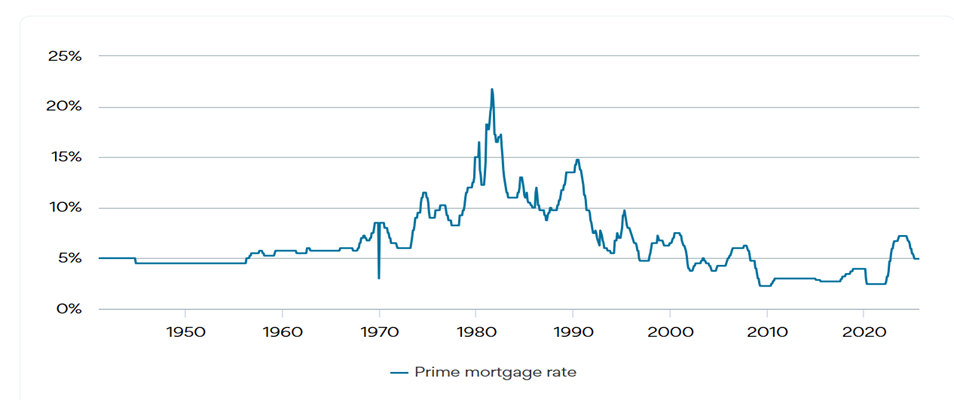
We’re often watching interest rates and have recently had conversations with lenders and mortgage brokers. At the beginning of September 2025, the best 5-year fixed rates were around 3.91%, and the best 5-year variable rates were around Prime -0.9% (which meant 4.05%.) If you were renewing a mortgage or negotiating a loan, the 3.91% fixed rate was a lower rate and could be tempting, but the chance of a Prime interest rate cut was being heavily discussed. Mid-September then rolled around and, with the wave of their magic wand, then Bank of Canada cut rates by 0.25%. The Prime -0.9% rate mentioned above was now at 3.8%, and anyone who chose the variable over the fixed rate felt like they won out.
The Bank of Canada has regular meetings throughout the year at which they announce their interest rate decisions. The next meeting is scheduled for December 2025, and the question remains: “Will they continue to cut rates?”
Why Do They Cut?
Central banks have a variety of reasons for cutting rates, and they usually revolve around economic conditions such as inflation, unemployment, and GDP growth. The Bank of Canada has been reluctant to cut rates amid a trade war with the United States, given the possibility that U.S. tariffs and Canadian counter-tariffs could push up consumer prices and reignite inflation.
But at the recent September rate announcement, the Bank of Canada had to pivot and cut rates as unemployment has risen, exports have plummeted and inflation has remained relatively stable. U.S. President Donald Trump’s tariffs have hammered Canadian exports, which fell 27% in the second quarter as tariff front-running went into reverse and U.S. demand dropped. Tiff Macklem, the Governor of the Bank of Canada, was recently quoted: “Tariffs are having a profound effect on several key sectors, including the auto, steel and aluminum industries. Chinese tariffs on canola, pork and seafood, new U.S. tariffs on copper, and higher U.S. tariffs on softwood lumber will spread the direct impacts further.” The unemployment rate also hit 7.1% in August, the highest level since 2016 outside the pandemic.
What Does the Future Hold?
There are two more interest rate announcements in 2025: October 29 and December 10. For the central bank to cut, much will depend on what happens on the trade front. Canadian Prime Minister Mark Carney has failed to secure a deal with U.S. President Donald Trump that would remove or lower tariffs. Mr. Carney has said he is now trying to secure small sectoral deals that would lower tariffs on steel, aluminum, autos and lumber, rather than a mega bargain that would deal with all tariffs.
The Canadian government is also shifting focus to the upcoming review of the United States-Mexico-Canada Agreement, the free trade pact that is currently protecting around 85 per cent of Canadian exports to the U.S. from tariffs.
The Bank of Canada gave no guidance about its plans for the October rate decision, or where interest rates might go from here. “We are paying close attention to how exports evolve given the impact of U.S. tariffs and changing trade relationships; how much this spills over into business investment, employment and household spending; how the cost effects of trade disruptions and reconfigured supply chains are passed on to consumer prices; and how inflation expectations evolve,” Mr. Macklem said.

The trade war uncertainty does leave the door open to another interest rate cut this year if economic growth remains weak while inflation remains under control. We continue to monitor interest rates and have meaningful discussions with our clients. This helps us provide valuable financial advice and will ultimately lead to better informed financial decisions. Please reach out if you think this could be of help to you.
Tax Planning
Tax planning can be also complex and hard to understand, because everyone's situation is unique. Below, we look at different financial situations and how we'd suggest each person proceed to get the most favorable result.
Learn More