Peter is turning 71 years of age this year. He is wondering what his options are with his registered funds (RRSPs).

What do with my RRSP savings?
Peter is turning 71 years of age this year. He is wondering what his options are with his registered funds (RRSPs).
He’s got $1,150,000 in RRSPs.
Peter must decide what to do with his RRSPs. You need to convert your RRSPs into a life annuity, transfer them into a RRIF, or take the funds in cash before the end of the year. If you choose the RRIF or life annuity option, you can defer the start of the income until your 72nd year.
Cash Option (withdraw the funds)
In BC, there is an extra tax rate at $252,000. Therefore, the marginal tax bracket including federal and provincial taxes is 53.5% at $252,000. This tax rate was set to try to capture additional income from high-income earners. However, this new tax bracket had the effect of catching many individuals on their final tax return. It really turned into a pseudo estate tax in BC.
If Peter took the funds in cash, he’d have to pay approximately $600,000 in income tax.
Registered Retirement Income Fund (RRIF) Option
The RRIF gives you more flexibility in dealing with your retirement capital, as does a life annuity. That means that, within limits, you control the amount of income you receive from your RRIF.
There is a minimum percentage of a RRIF that must be taken as taxable income each year. You can choose to take more than the minimum in any year.
Peter will be required to take out 5.28% of the balance of his RRIF in 2025 – approximately $60,720. This represents the statutory RRIF minimum payment. He can take the payments monthly, quarterly, semiannually, or annually. The minimum required withdrawal percentage increases every year (RRIF withdrawal schedule).
Life Annuity
While not as flexible as a RRIF, a life annuity is like a defined benefit pension plan. You exchange your RRSP funds for a guaranteed level of increasing income for your entire life, no matter how long you live.
Which option should Peter choose?
Peter’s life expectancy is approximately 17 years, or until he is 88 years of age. Life expectancy is one of the most misunderstood aspects of retirement income planning – yet it is one of the most important factors.
Most people assume that life expectancy is the same as lifespan. This is not correct. Instead, life expectancy is the median number of years people of a particular age group will continue to live. In other words, 50% of a particular age group will die before this number of years and the other 50% will die after. Peter has a 50% chance of living beyond 88 years of age. He has a 25% of reaching 93 years of age.
If Peter invested $100,000 in a life annuity, he could generate a monthly income of approximately $713 for the rest of his life.
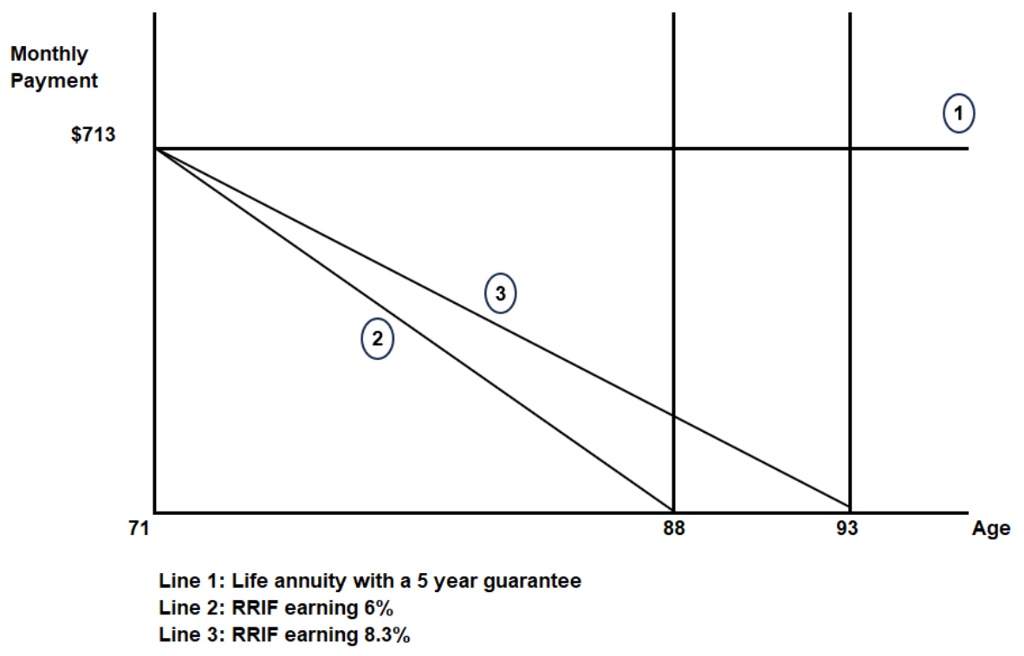
If instead Peter invested $100,000 in a RRIF and withdrew $713 per month, he would need to earn approximately 6% to have his income last 17 years. He would need to earn 8.3% to have his income last 22 years (age 93) at a $713 per month withdrawal.
There are three stages to retirement: the first stage is called the “Go-Go” stage, the second is the “Slow-Go” stage and the third is the “No-Go” stage. We would all like to spend most of our retirement in the ‘Go-Go” stage of retirement. This stage of retirement is typically very active as your energy is high and you are fulfilling your retirement dreams. The “Slow-Go” stage is when your energy starts to wane. Your health may not be a major factor, but you don’t have as much energy as you did earlier in retirement. You probably have seen older relatives or friends go through this stage. The “No-Go’”stage is when your activities are restricted because of health and other physical or mental impediments.
Over the years of helping clients move to retirement, we’ve seen the following pattern. The first two years of retirement tend to be the most expensive, as you are dealing with pent-up demand that you did not fulfil while working full time. The first two years are often treated like a vacation; it can be very expensive.
In some cases, the last two years of retirement can also be very expensive because of long-term care costs.
We’ve also found that our clients do not need to increase their income every year by the rate of inflation to maintain their lifestyle in retirement. In most cases, they usually only increase their income every three to four years.
We’ve found that many clients start to slow down later in retirement and spend less money as they become less active. This slowdown in activity tends to become quite pronounced around the age of 80.
Solution
We typically suggest our clients wait until they are in their mid-to-late 70s before considering the purchase of a life annuity. We find clients typically want more income flexibility in the “Go-Go” years in retirement.
Earlier in retirement, we would suggest that Peter transfer his RRSP funds into a RRIF to give him the maximum flexibility earlier in his retirement years.
The only caveat is if Peter only invests in GICs, he should consider transferring a portion of his RRSPs into a life annuity today.
Would you like to have Clay
review your financial situation?
More articles from Clay’s
Retirement Makeover Series

Ben is 61 years of age. Karen is 55 years of age. They are wondering what type of retirement lifestyle their current assets and pension entitlements will generate for them.

Peter is turning 71 years of age this year. He is wondering what his options are with his registered funds (RRSPs).

Should Peter and Angela continue to take out the minimum from their RRIFs or increase their income?

Joan is 60 years old. She is wondering if she can generate an after-tax income of $80,000 per year in retirement.

Client Retirement Video Story
“We’re very dependant on Clay and his team. It’s a bit like hiring a good family physician.”


Read more from Clay at…